

Nobody can really date what they watch. We place Breaking Bad "around 2010", Lost "mid-2000s", and we're three years off both times. This game puts a number on that vagueness.
Ten rounds, one slider
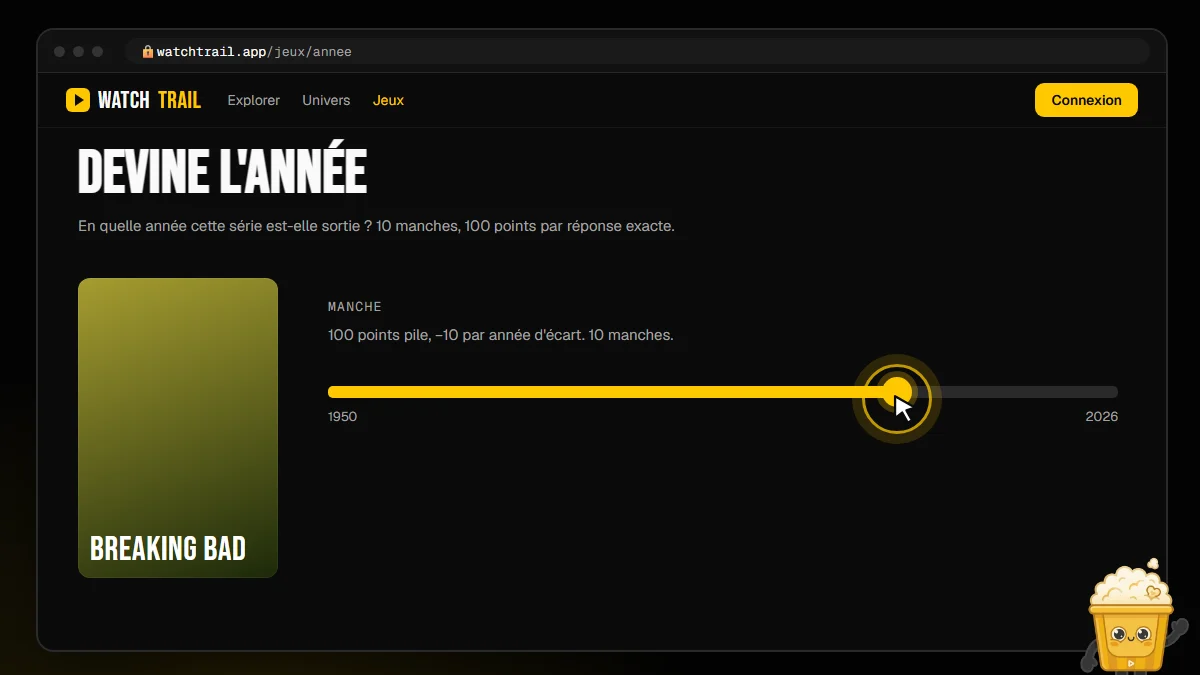
A poster appears, you place a slider between 1950 and today, you confirm. The scoring is deliberately harsh:
- 100 points for the exact year.
- 10 points fewer per year off.
- Zero at ten years off or more.
Ten rounds, so 1,000 points maximum. Reaching 600 is already a good score: it implies an average error under four years across ten titles.
What "the year" means
One clarification that heads off arguments: for a show, the year used is the first air date — not the season you watched, nor when it was filmed. For a film, it's the release date.
That matters because long-running shows scramble intuition. Grey's Anatomy has 465 episodes to date, but the year that counts here is 2005, the first episode's.
Shows and films mixed
The draw pulls from current trending and best-rated titles, shows and films together. Two consequences: the pool shifts week to week, and you jump without warning from a recent blockbuster to a 1990s series. The mix is deliberate — dating a film and dating a show don't call on the same landmarks.
The game plays without an account, your best score stays on your device, and nothing leaves for a server mid-game.
 Play Guess the year
To place a show precisely
Every page shows the first air date, the episode count and the total watch time. If you hesitated on Stranger Things, its page will tell you the exact year — and offer to pick your tracking back up where you left it.
Three cues to be less wrong
Dating an image is a skill. Three cues are enough to gain five years of accuracy, and they're visible on the poster itself.
- The poster's composition. Very dark layouts with a close-up face and a thin-lettered title are a 2010s signature. The 1990s embrace the character-collage montage.
- Grain and colour grading. The blue-and-orange grade takes hold in the mid-2000s; before that, tones are more neutral and contrast flatter.
- How many cast names are pushed forward. A wide billed cast usually means an ensemble show, the dominant 2000s format.
These cues don't replace knowledge, they supplement it: when you don't know a title at all, they beat leaving the slider in the middle.
Why 1950 as the floor
The floor isn't decorative. Scripted television becomes an industrial format in the early 1950s, and the catalogues we query are thin before then. Setting 1950 avoids offering a slider whose bottom third never gets used — and concentrates precision where the titles actually are.