
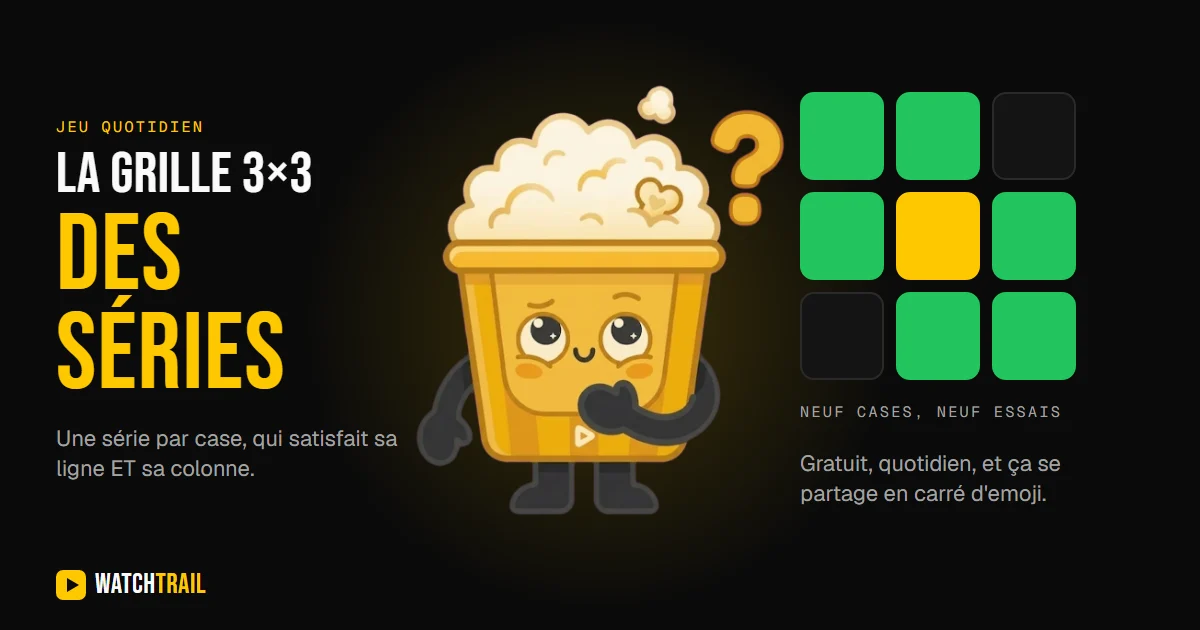
The format comes from sports: a nine-cell grid, criteria across rows and columns, and a player to find at each intersection. Transposed to TV, it becomes a very particular knowledge test — not "do you know this show", but "how many shows can you summon under constraint".
How it plays
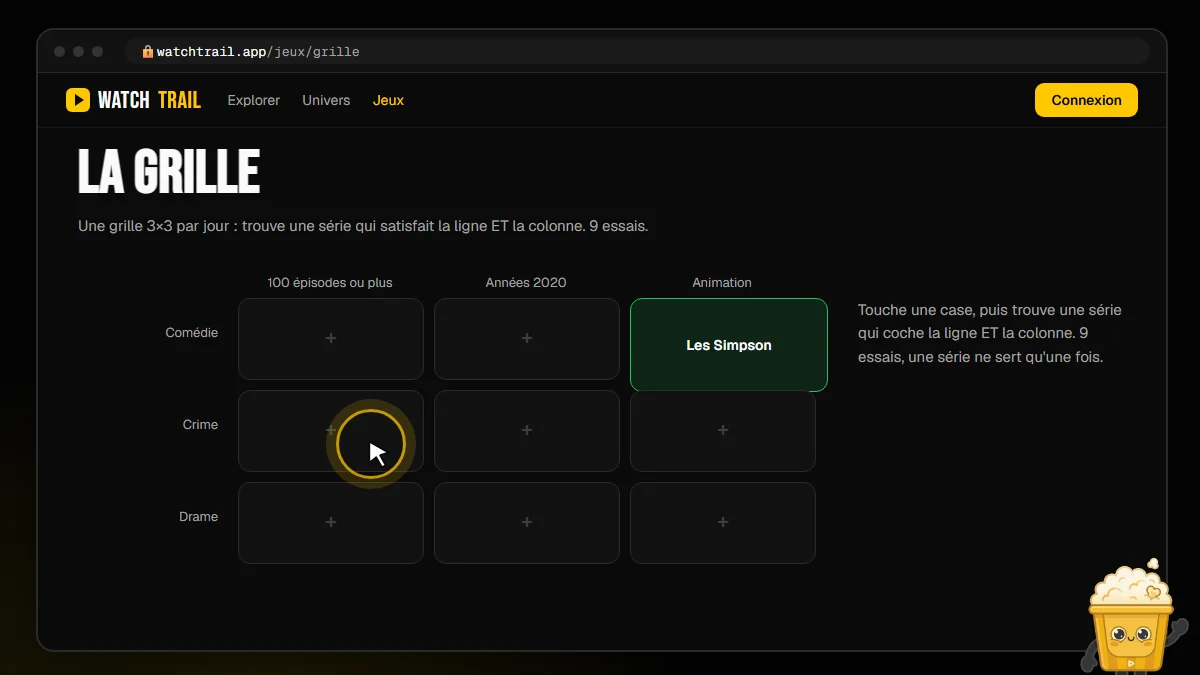
Three criteria across rows, three down columns. Each cell wants a show that satisfies both at once: "Animation" crossed with "100 episodes or more", "Drama" crossed with "the 1990s", "Sci-Fi" crossed with "rating ≥ 8.4".
- Nine guesses total, not nine per cell: every attempt counts, right or wrong.
- A show can only be used once — you can't fill three cells with the same title.
- The counter in each cell shows how many valid answers exist. That's deliberate help: the cell reading "2 possible" is where to think.
A guess that doesn't fit tells you so plainly and uses up an attempt. The grid ends when the nine guesses are spent, or when all nine cells are filled.
The criteria are facts, not opinions
This is what decides whether a game like this is playable or maddening. Our categories cross only verifiable attributes: genre, decade, country of origin, episode count, public rating. No "best shows of", no subjective ranking — otherwise you argue about the answer instead of playing.
The pool covers 571 shows, eight decades (from the 1950s to the 2020s) and sixteen countries of origin, from the United States to South Korea by way of the United Kingdom, Japan, France, Spain or Turkey.
The guarantee we had to add
A random grid draw regularly produces single-answer cells. That isn't a game any more, it's a riddle: either you know THE show that ticks both boxes, or you burn a guess and learn nothing.
 Play The Grid
So a day's draw is only kept if every cell admits at least two answers. The program searches until it finds a combination satisfying that condition everywhere — and falls back to a broader set of criteria if it can't.
Sharing
At the end, the result copies as an emoji square: three rows of three, green for filled, white for missed. No show is named, so nothing is spoiled for someone who hasn't played yet. The grid changes daily at midnight UTC, the same for everyone.
If the decade criteria made you hesitate, a show's page gives its exact first air date — Game of Thrones's, for instance. And for finding shows by genre, exploring is built for that.